Adapting Shore-Power Electrical Topologies Across Continental Grids
Shipping an identical off-the-shelf concession unit to customers in Texas, London, and Sydney guarantees that at least two of those buyers will fail their local utility inspections on day one. When an experienced engineering team designs a custom mobile food trailer for international deployment, the first subsystem tailored to the destination port is the shore-power electrical architecture. North American commissaries and festival grounds run on split-phase 120/240-volt, 60-hertz power governed by NFPA 70 National Electrical Code rules, requiring heavy four-wire twist-lock inlets and dedicated ground-fault circuit interrupter breakers on every wet counter receptacle. Across the European Union and the United Kingdom, municipal hookups supply single-phase 230-volt or three-phase 400-volt, 50-hertz electricity through blue or red IEC 60309 waterproof commando plugs protected by residual current devices. Meanwhile, Australian and New Zealand inspectors enforce AS/NZS 3001 standards for transportable structures, mandating double-pole switching on every socket outlet and recessed external power inlets with reverse-polarity indicators. Customizing the internal copper wire gauges, breaker enclosures, and conduit paths on the factory assembly line saves overseas buyers from ripping open insulated walls to rewire the vehicle after customs clearance.
Chassis Braking Mechanics, Coupler Standards, and Curb-Side Door Orientation
Roadway legality changes just as drastically across borders as electrical voltage. A running gear setup that cruises legally down an interstate highway in California will be impounded immediately at a roadside inspection in Germany or Queensland. Tailoring the structural chassis to global department of transportation rules involves engineering three mechanical assemblies:
-
Braking actuation systems: While North American trailers rely heavily on 12-volt electric drum brakes triggered by an in-cab proportional controller, European road laws under UN/ECE Regulation 13 mandate mechanical overrun inertia brakes paired with auto-reverse torsion axles and EC type-approval E-markings.
-
Tow-hitch couplers and safety chains: US and Canadian pickups use two-inch or two-and-five-sixteenths-inch ball couplers, European tow bars require fifty-millimeter ISO ball couplings, and Australian outback builds frequently specify heavy-duty articulating poly-block or ADR-approved fifty-millimeter couplings with rated D-shackles.
-
Serving window and curb-side door handedness: In right-hand traffic nations across the Americas and continental Europe, the main concession serving window sits on the right-hand passenger wall so customers queue safely on the sidewalk; for left-hand traffic markets like the UK, Australia, Japan, and New Zealand, the entire floorplan mirrors horizontally so the serving hatch opens onto the left-hand curb.
Regional Engineering Specification Matrix for Global Markets
Aligning chassis hardware, utility hookups, and sanitation layouts to regional statutory codes ensures smooth registration across target export destinations.
| Engineering Subsystem | North America (USA & Canada) | European Union & UK | Australia & New Zealand | Middle East & Gulf States |
|---|---|---|---|---|
| Shore Power & Frequency | 120/240V Split-Phase, 60 Hz (NEMA plugs) | 230V Single / 400V 3-Phase, 50 Hz (IEC 60309) | 230V/240V, 50 Hz (AS/NZS 3001 double-pole) | 220V/380V, 50/60 Hz, high-load AC circuits |
| Axle & Brake Architecture | DOT electric brakes + breakaway battery | AL-KO/Knott mechanical overrun inertia brakes | ADR electric or override brakes + heavy chains | Heavy-duty leaf-spring or torsion dual axles |
| Hitch Coupler Standard | 2" or 2-5/16" SAE ball coupler | 50 mm ISO 50 ball coupling with spherical wear indicator | 50 mm ADR ball or off-road articulating hitch | 50 mm ball or heavy pintle ring eye |
| Curb-Side Serving Window | Right-hand side (Passenger side) | Right-hand (EU) / Left-hand (UK & Ireland) | Left-hand side (Passenger curb side) | Right-hand side with dust-sealed gaskets |
| Potable Water & Sinks | NSF 3-compartment sink + handwash sink | CE food-grade tubing, dual or triple basins | WaterMark certified fittings, dual/triple sinks | Oversized freshwater tanks, high-CFM hoods |
The specification matrix above demonstrates why one-size-fits-all mass production fails in mobile commerce: forgetting to mirror the floorplan for a Melbourne or London buyer leaves customers standing in active traffic lanes to order food.
Field Lessons from a Multi-Country Specialty Coffee and Pastry Brand Rollout
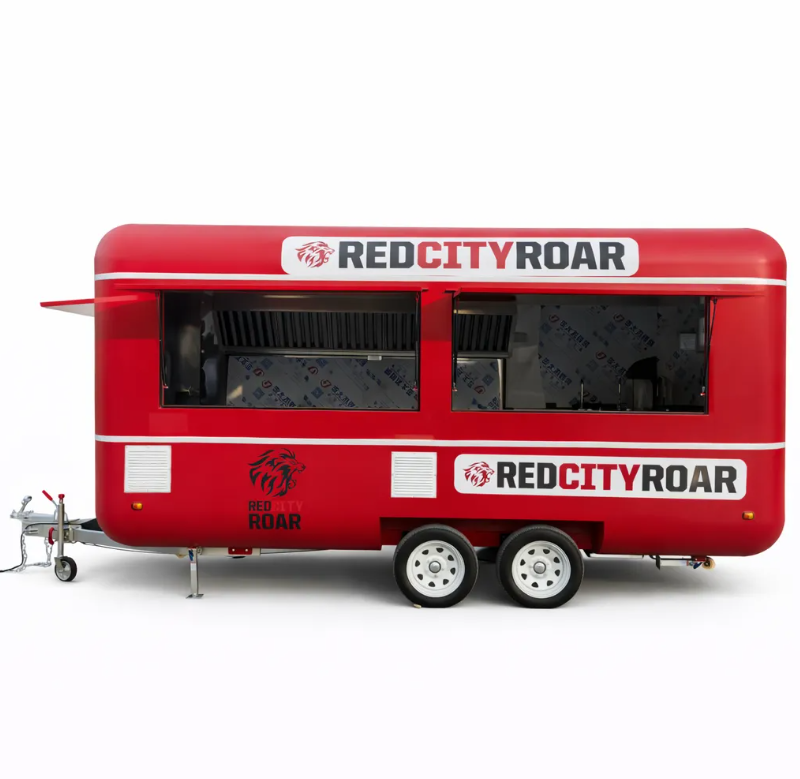
Launching a unified visual brand across multiple continents requires separating exterior aesthetic consistency from underlying regulatory mechanics. During an international expansion for a specialty espresso and artisanal churro franchise opening mobile kiosks simultaneously in Austin, London, and Melbourne, the brand directors needed twelve identical-looking vintage airstream-style trailers. An early quote from a domestic upfitter proposed building twelve identical US-spec units and letting regional franchisees modify them locally. A pre-build engineering audit revealed that local retrofitting would cost nearly forty percent of the vehicle price per unit because moving the serving window from the right wall to the left wall for London and Melbourne meant cutting through structural steel ribs and relocating the entire espresso plumbing line. Partnering directly with a global custom manufacturer solved the dilemma on the CAD drawing board. The factory maintained identical polished exterior proportions and brand signage across all twelve units, while splitting the production run into three regional engineering tracks: left-hand serving windows with AS/NZS 3001 double-pole wiring for Melbourne, UN/ECE mechanical overrun brakes and 230V commando inlets for London, and DOT electric brakes with четырех-sink NSF sanitation stations for Austin. Every unit cleared local road and health registration within two weeks of port arrival.
Climate Insulation Boundaries and Sourcing Turnkey Mobile Complexes
Beyond statutory codes, regional climate extremes dictate wall insulation and HVAC sizing. A unit bound for summer street markets in Dubai or Riyadh requires high-density polyurethane foam insulation, solar-reflective roof coatings, and dedicated tropical-rated split air conditioning so under-counter refrigerators do not trip thermal overloads in forty-five-degree-Celsius heat. Conversely, Nordic and Canadian winter concessions need heated underbelly utility bays and insulated double-glazed serving windows.
For global franchises, hospitality groups, and independent entrepreneurs seeking deeply customized units across food trailers, mobile retail shops, camper solutions, and turnkey commercial complexes, Mingtai operates a 70,961-square-meter modern manufacturing facility staffed by over two hundred professionals. Led by engineering and design experts with more than thirty-five years of industry experience across a catalog of over two hundred models, the factory translates regional road, electrical, and hygiene regulations into compliant, ready-to-trade mobile workspaces worldwide.
Table of Contents
- Adapting Shore-Power Electrical Topologies Across Continental Grids
- Chassis Braking Mechanics, Coupler Standards, and Curb-Side Door Orientation
- Regional Engineering Specification Matrix for Global Markets
- Field Lessons from a Multi-Country Specialty Coffee and Pastry Brand Rollout
- Climate Insulation Boundaries and Sourcing Turnkey Mobile Complexes