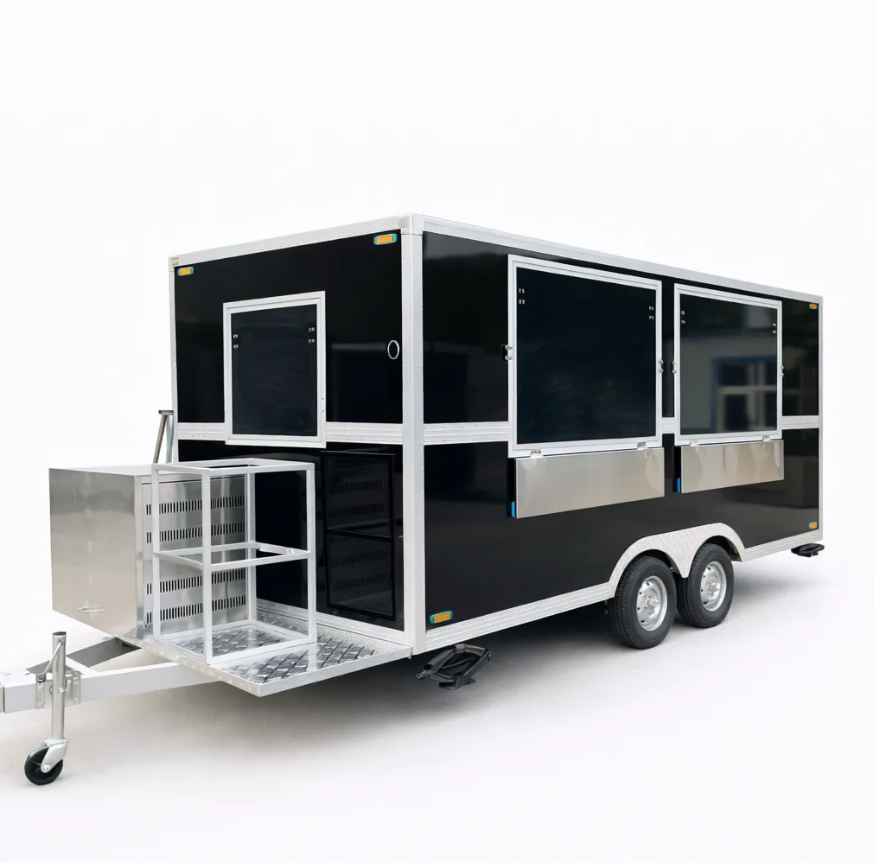
The Self-Contained Kitchen Concept and What It Replaces
Traditional off-site catering operates on a logistics chain that every event planner knows by heart. Food is prepared hours before service in a commissary kitchen located miles from the event venue. It is packed into insulated carriers, loaded into vans, driven across town, unloaded, and set up in a temporary staging area behind a tent or inside a venue's back hallway. The kitchen team then spends the next hour reassembling the meal, reheating proteins, dressing salads, and trying to restore the freshness that was lost somewhere between the commissary and the serving table. The result is a meal that is competently executed but rarely exceptional, because the distance between the kitchen and the guest has introduced too many compromises. A full-kitchen food truck designed for one-stop catering eliminates this entire logistics chain. The kitchen travels with the food. Every piece of cooking equipment, every refrigerated drawer, every prep surface, every sink, and every plate leaves the commissary as a complete, self-contained unit and arrives at the event ready to cook. The chef steps into the same kitchen they prepped in, fires the same equipment, and executes the menu from raw ingredients to finished plates within arm's reach of the guests. The food is served at the peak of its quality because it was cooked moments before it was handed across the service counter. This is not a food truck in the street-vending sense, rotating through a lunchtime parking spot and serving a limited menu of handheld items. This is a mobile restaurant kitchen, purpose-built to deliver the quality and service level of a stationary catering kitchen at any location the client chooses.
The Cooking Line and the Power of On-Site Preparation
The heart of a one-stop catering food truck is its cooking line, and the configuration of that line determines what the kitchen can produce. A properly equipped full kitchen in a mobile format is not a scaled-down version of a restaurant kitchen with compromises made for space. It is a compact, highly efficient layout where every piece of equipment earns its place. A flat-top griddle provides the broad, even heat needed for searing proteins, cooking breakfast items, and handling high-volume service. A deep fryer station, with its own dedicated ventilation capture, handles fries, appetizers, and breaded items that are at their best seconds after leaving the oil. A range with multiple burners allows for saute work, sauce preparation, and the cooking of pasta and grains. A combi oven or convection oven expands the menu into baked items, roasted vegetables, and slow-cooked proteins that would be impossible on a griddle or fryer alone. The ventilation hood spanning the entire cooking line is not optional equipment. It is a code requirement and an operational necessity that removes grease-laden vapor, combustion byproducts, and heat from the kitchen compartment, keeping the air breathable and the equipment surfaces free of grease buildup. The hood's fire suppression system, integrated with the exhaust and the cooking equipment fuel supply, provides the automatic protection that a health inspector and a fire marshal both require. The cooking line, taken as a whole, enables a menu that is not limited to what can survive a half-hour ride in a Cambro carrier. It enables a menu that is cooked to order on site, with all the texture, temperature, and visual appeal that implies.
Refrigeration, Storage, and the Cold Chain Integrity
A kitchen that cooks on site must also store on site, and the cold chain from commissary to service is only as strong as the refrigeration built into the truck. Undercounter refrigerated drawers and reach-in upright units, each designed for commercial mobile use with reinforced door latches and compressor systems that tolerate road vibration, hold raw proteins, dairy, fresh produce, and prepared components at safe holding temperatures throughout the travel and service period. The layout of the cold storage within the kitchen workflow is a detail that separates a thoughtfully designed truck from a haphazard one. The refrigeration unit that holds raw chicken should not be positioned where the prep cook must carry raw product across the path of finished plates leaving the pass. The reach-in that holds garnishes and cold sauces should be accessible from the assembly and plating zone without the expediter having to weave through the hot cooking line. These workflow considerations, designed into the kitchen at the manufacturing stage, reduce cross-contamination risk, improve service speed, and make the health inspector's job easier when they walk through for the permitting review. Dry storage for non-perishable ingredients, paper goods, and cleaning supplies must also be integrated into the kitchen footprint without encroaching on the cooking and preparation zones. A full-kitchen truck that runs out of a key ingredient mid-service because the dry storage is a single undersized cabinet behind the driver's seat is not a full-kitchen truck. It is a marketing claim that collapses under the weight of a real service.
The Wash Station, Sanitation, and Health Code Compliance
Health departments across North America enforce a consistent set of requirements for any facility that prepares and serves food to the public, whether that facility is a brick-and-mortar restaurant or a mobile unit. A full-kitchen food truck must satisfy these requirements without relying on external facilities. This means a dedicated handwashing sink with hot and cold running water, a soap dispenser, and a single-use towel dispenser, positioned for easy access from the food preparation and cooking zones. It means a three-compartment sink, each basin large enough to submerge the largest piece of equipment used in the kitchen, with integral drainboards for clean and soiled items, used for the manual washing, rinsing, and sanitizing of utensils, pots, and pans. The hot water heater must be sized to supply both the hand sink and the three-compartment sink at the temperatures required by the local health code, continuously, for the duration of a service that may last six or eight hours. The fresh water tank and the grey water tank must be sized with a capacity margin that ensures the kitchen does not run out of clean water or overflow its waste tank before the service period ends. These systems are not glamorous. Customers never see them. But a health inspector sees them, and a kitchen that fails a health inspection because its wash station was an afterthought is a kitchen that does not serve food that day. The engineering of the water, waste, and sanitation systems is every bit as important to the one-stop catering concept as the cooking equipment itself.
Power, Water, and the Independent Utility Envelope
The ability of a full-kitchen food truck to operate as a one-stop catering solution depends on its ability to function independently of the event venue's utilities. The venue may have no accessible power. The water spigot may be a hundred yards away. The truck must arrive with everything it needs to run a complete service, and that begins with the onboard generator and electrical distribution system. The generator, sized to handle the combined running load of all cooking, refrigeration, ventilation, lighting, and water heating equipment, plus the starting surge of the largest motor load, typically a compressor or a hood fan, must run reliably and quietly enough that it does not disrupt the event it is serving. The electrical distribution panel, matched to the generator output and to the load calculation of the kitchen equipment, routes power through properly sized breakers and conductors to every appliance, outlet, and light fixture. The fresh water system, with its pump, pressure tank, filtration, and distribution piping, delivers potable water to the sinks and any water-connected equipment. The grey water tank collects the waste from those sinks and holds it until a proper dump station is available. An independent utility envelope means the truck can park at a wedding venue with no facilities, a corporate campus courtyard with no accessible hookups, or a rural event site with nothing but open ground, and still deliver a full catering service without compromise. This independence is what transforms a food truck from a vending unit into a true mobile catering kitchen.
The Manufacturing Advantage of a Purpose-Built Full-Kitchen Platform
A food truck that supports one-stop catering is not a standard truck with cooking equipment bolted inside. It is a purpose-built platform where the kitchen layout, the equipment selection, the ventilation, the electrical system, the plumbing, and the structural reinforcement are engineered to work together as an integrated whole. Retrofitting a used step van with mismatched appliances and a consumer-grade electrical system may produce a vehicle that can serve hot dogs at a park. It will not produce a vehicle that can execute a plated three-course dinner for a hundred guests at a vineyard wedding. Trailer Factory Co builds mobile kitchen food trucks with this integrated design philosophy, manufacturing units where the full kitchen is not an option added to a standard trailer but the organizing principle of the entire build. For a catering business owner, this integration means receiving a truck that has been designed for the operational reality of high-volume, on-site food service: the cooking line flows into the plating zone, the refrigeration is positioned within the prep workflow, the wash station is sized for real use, the power and water systems are matched to the menu's demands, and the entire unit is built to the standards that health and safety authorities expect. The result is not just a vehicle with a kitchen inside. It is a mobile catering platform that delivers on the promise of its concept: one truck, one team, one location, and a complete dining experience that does not ask the client to manage the logistics of a remote kitchen, a transport chain, and a make-do finishing station. That simplicity, the elimination of the traditional catering supply chain in favor of a single self-contained unit, is the operational and commercial definition of one-stop catering.
Table of Contents
- The Self-Contained Kitchen Concept and What It Replaces
- The Cooking Line and the Power of On-Site Preparation
- Refrigeration, Storage, and the Cold Chain Integrity
- The Wash Station, Sanitation, and Health Code Compliance
- Power, Water, and the Independent Utility Envelope
- The Manufacturing Advantage of a Purpose-Built Full-Kitchen Platform