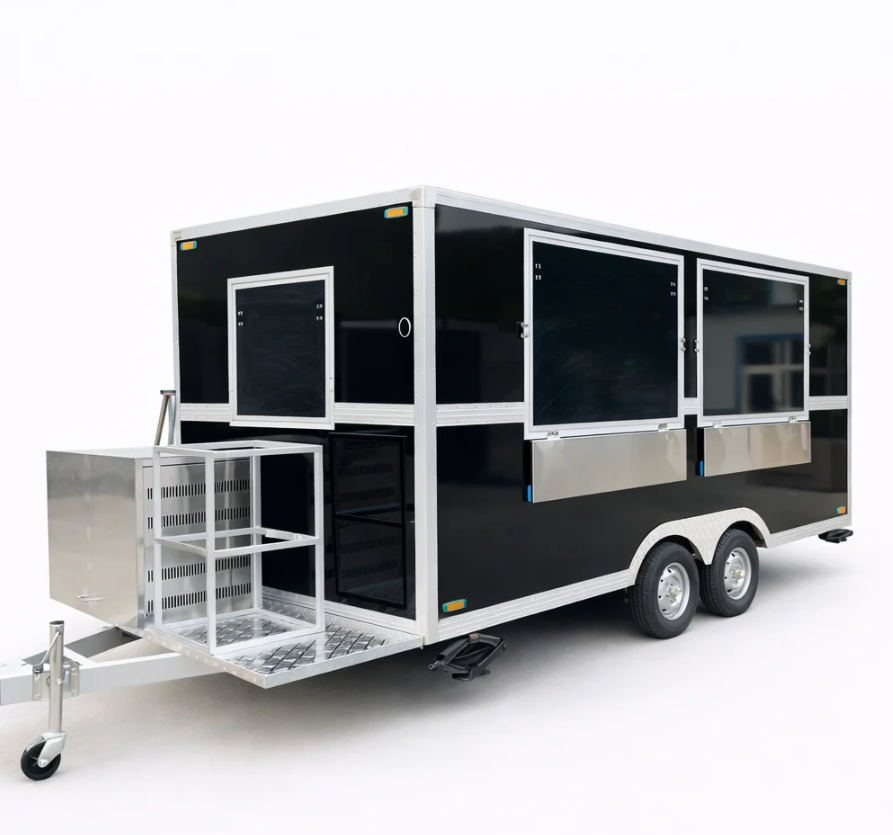
Starting with the Load Calculation and the Total Power Picture
The electrical system of a mobile kitchen food trailer does not begin with a wire or a breaker. It begins with a list. Before a single component is purchased or a single conductor is pulled, the builder or owner must conduct a thorough load calculation that accounts for every electrical device that will ever operate inside that trailer, including the ones that might be added a year from now. The process is methodical and unforgiving of optimism. Walk through the trailer in your mind, station by station. List the commercial refrigerator, the freezer, the exhaust hood fan, the ventilation blower, the water pump, the water heater, the interior and exterior lighting, the point-of-sale tablet, the phone charger, the sound system. Then list the heavy hitters: the cooking equipment. A commercial induction cooktop, a panini press, a deep fryer, a microwave, an espresso machine. Each of these appliances draws current at its rated wattage when running, and some, particularly those with motors or compressors, draw a significantly higher surge current at startup. The load calculation must account for the running watts of all equipment that could operate simultaneously, plus the starting surge of the largest motor or compressor. This total, divided by the system voltage, yields the minimum amperage that the main service must supply. A trailer loaded with electric cooking equipment can easily push past what a 30-amp service can deliver, moving the requirement firmly into 50-amp territory or beyond. Performing this calculation honestly, with no wishful thinking about what might not be turned on at the same time, is the foundational act of electrical design. Every wire size, every breaker rating, and every component selection that follows depends on this number being correct.
Selecting the Main Breaker, Inlet, and Shore Power Configuration
Once the total service size is determined, the main breaker and the shore power inlet become the gateway through which all electricity enters the trailer. In Canada, mobile food trailers commonly connect to power at events, campgrounds, and commercial kitchens through either a NEMA 14-50R 50-amp receptacle, a NEMA TT-30R 30-amp receptacle, or less commonly a NEMA L14-30R 30-amp locking receptacle. The main breaker inside the trailer's distribution panel must match the rating of the shore power inlet and cord. A 50-amp inlet connected to a main breaker rated higher than 50 amps is a fire hazard because the shore power pedestal's breaker will not trip before the trailer's wiring is overloaded. The shore power cord itself must be rated for outdoor use in Canadian conditions, with insulation that remains flexible in sub-zero temperatures and that resists the degradation caused by repeated coiling, uncoiling, and exposure to rain, snow, and road salt spray. The inlet box mounted on the exterior of the trailer must be weatherproof when the cord is connected and when the cover is closed, and it must be positioned where it will not be damaged by road debris or interfere with the trailer's movement. For trailers that may operate in both 50-amp and 30-amp locations, a properly wired adapter that safely derates the trailer's total capacity is essential, but this adapter must never bypass the main breaker's protective function.
Wire Gauge Selection and the Voltage Drop Consideration
Matching wire gauge to the circuit breaker is not a simple lookup exercise. The ampacity of a conductor, the maximum current it can carry safely without overheating, depends on its material, its cross-sectional area measured in American Wire Gauge, its insulation temperature rating, and the environment in which it is installed. A wire routed through a hot ceiling cavity above a cooking line, bundled with other current-carrying conductors, will have a lower ampacity than the same wire run alone in free air. The Canadian Electrical Code requires that conductors be sized not only for the breaker's rating but for the conditions of use, and it mandates derating factors for high ambient temperatures and for multiple conductors in a single conduit or raceway. Beyond ampacity, voltage drop is the silent performance killer in mobile kitchen electrical systems. A long wire run from the distribution panel at one end of the trailer to a high-current appliance at the other end can lose enough voltage along the way that the appliance receives significantly less than the nominal 120 volts it expects. A refrigerator compressor running on low voltage works harder, runs hotter, and fails earlier. An induction cooktop on low voltage delivers less cooking power. The solution is to increase the wire gauge for long runs, using a larger conductor than the minimum required by the ampacity tables, to keep the voltage drop below a practical threshold. This adds material cost but protects the longevity of every appliance on the circuit.
Branch Circuit Breakers and the Protection of Individual Appliances
Downstream of the main breaker, the distribution panel divides the incoming power into branch circuits, each protected by its own breaker and each serving a specific set of loads. The matching of breaker to wire to load is where the precision of the design is most visible. A 20-amp breaker protecting a circuit wired with 12 AWG copper conductors is a standard pairing for general-purpose kitchen receptacles. A 15-amp breaker on a 14 AWG circuit serves lighting and lower-power devices. The critical rule, enforced by code and by the physics of electrical safety, is that the breaker must be the weakest link in the chain. It must trip at a current lower than the ampacity of the wire it protects. A circuit wired with 14 AWG conductors and protected by a 20-amp breaker violates this principle because the wire can overheat and ignite before the breaker ever trips. Dedicated circuits for individual high-power appliances are not a luxury in a food trailer. They are a necessity. A commercial espresso machine that draws 15 amps should be on its own circuit, not sharing a 20-amp breaker with a panini press that draws 12 amps. The simultaneous operation of both would trip the shared breaker at the busiest moment of service. The selection of breaker type also matters. Ground Fault Circuit Interrupter breakers or receptacles are required by the Canadian Electrical Code for receptacles installed in wet locations, which in a food trailer includes any receptacle within a certain distance of a sink or a water source. These breakers detect the tiny current imbalance that occurs when electricity finds an unintended path to ground, through water or through a person, and they trip in milliseconds to prevent electrocution.
Distribution Box Layout, Grounding, and the Bonding Requirement
The interior of the distribution box is the nerve center of the trailer's electrical system, and its layout must reflect a clear separation of functions. The neutral bus bar, where all the white grounded circuit conductors terminate, and the ground bus bar, where all the bare or green equipment grounding conductors terminate, must be electrically separate in a sub-panel configuration, which is what a food trailer distribution panel is when fed from a shore power pedestal. The neutral and ground are bonded together at the main service panel upstream, typically at the campground or venue distribution point, and bonding them again inside the trailer creates a dangerous parallel path for neutral current that can energize the trailer's metal frame and skin. The grounding electrode connection, the bond between the trailer's ground bus and the trailer's metal frame and body, is what ensures that a fault that energizes the trailer's skin will draw enough current to trip the breaker instantly rather than waiting for a person to touch the energized surface and complete the circuit through their body. This grounding and bonding must be done with connectors rated for the purpose, attached to a clean, paint-free section of the trailer frame, and protected from corrosion. A ground connection that looks solid but has rust forming between the lug and the steel is a ground connection that may not carry fault current when it is needed most.
Manufacturing Quality and the Advantage of Pre-Engineered Electrical Systems
The electrical system of a mobile kitchen trailer is not a collection of individual parts that can be selected from a hardware store and assembled on the fly. It is an engineered system where every component, the main breaker, the distribution panel, the wire gauge, the receptacles, the grounding scheme, the labeling, must work together as a coherent whole under the demanding conditions of a mobile food service environment. Vibration from travel loosens connections that were not properly torqued. Heat from cooking equipment ages insulation faster than expected. Moisture from steam, cleaning, and weather finds every inadequately sealed penetration. A trailer that arrives in Canada with an electrical system designed and installed by a manufacturer that understands the Canadian Electrical Code, the provincial inspection process, and the real-world operating conditions of food trailers saves its owner from a costly and time-consuming process of rework, inspection failure, and delayed permitting. Trailer Factory Co builds mobile kitchen food trailers with this integrated understanding, producing units where the wire and distribution box matching is addressed at the design stage rather than left as a problem for the end user to solve. For a food entrepreneur preparing to enter the Canadian market, this integration means receiving a trailer whose electrical system is ready for the provincial inspection authority review, ready for connection to standard Canadian shore power, and ready to power a busy kitchen through the lunch rush without a breaker tripping or a wire overheating. The electrical system is not visible to the customer standing at the service window, but its design and execution determine whether the kitchen behind that window can operate reliably, safely, and without interruption.
Table of Contents
- Starting with the Load Calculation and the Total Power Picture
- Selecting the Main Breaker, Inlet, and Shore Power Configuration
- Wire Gauge Selection and the Voltage Drop Consideration
- Branch Circuit Breakers and the Protection of Individual Appliances
- Distribution Box Layout, Grounding, and the Bonding Requirement
- Manufacturing Quality and the Advantage of Pre-Engineered Electrical Systems