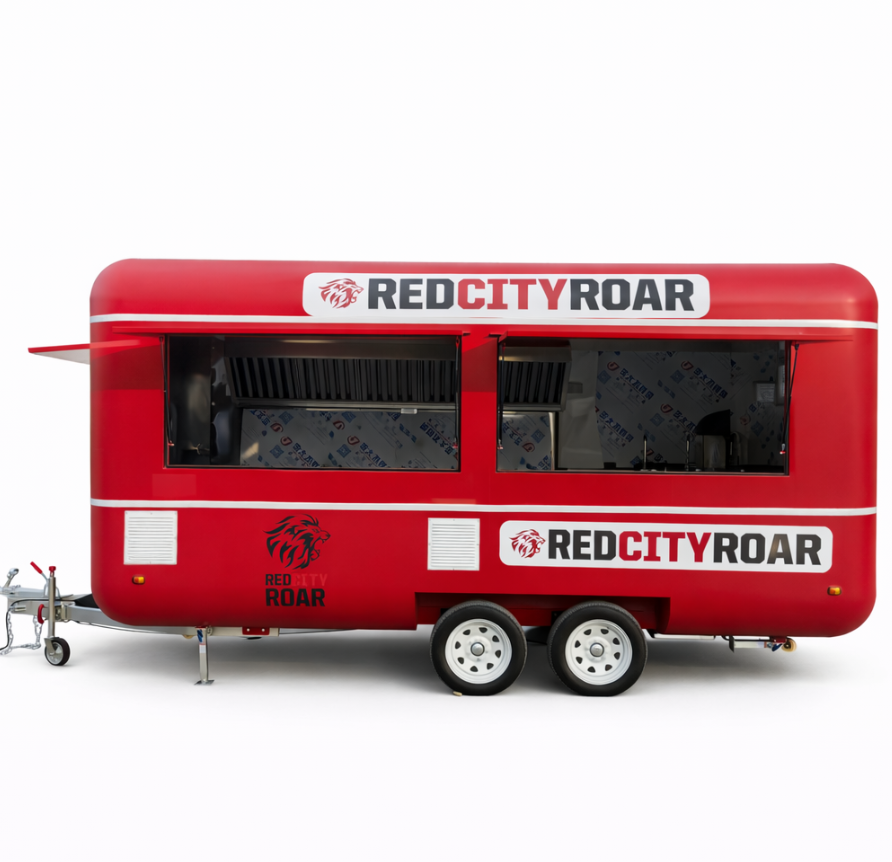
Start With the Power Supply, Not the Menu Board
A hot dog food trailer for sale can look ready on the lot, but the electrical package decides whether it survives a real service day. The menu board, steam table, fridge, lights, and POS all compete for a limited power budget. A trailer rated at 30 A shore power cannot carry a 50 A cooking load just because the breaker panel has room for extra circuits. Start with a load calculation that separates continuous loads from intermittent ones. Continuous loads run at 100 percent for three hours or more, so they get sized at 125 percent under common code practice. Intermittent loads still matter, but the calculation should reflect how the trailer actually works during a lunch rush. If the numbers are fuzzy, the safest path is a larger service, a clearly labeled panel, and a written load schedule that travels with the trailer.
Match Every Connector to Its Real Environment
Electrical accessories on a mobile food unit live in a rough place. Grease, steam, hose water, road vibration, and UV exposure all attack weak points. A standard indoor outlet in an exterior box is not the same product as a sealed, corrosion resistant assembly. The difference shows up at the shore power inlet, the receptacle covers, the strain reliefs, and the junction boxes under the sink. Builders who chase the lowest parts cost often save a few dollars at the factory and pay for it in callbacks. A better rule is to match the enclosure rating to the washdown routine. If the trailer gets hosed down nightly, the electrical gear should be selected for wet locations, not just damp ones.
GFCI, Overcurrent, and Grounding Work as a System
Ground fault circuit interrupter protection is not a decorative add on. GFCI receptacles listed to UL 943 are designed to trip at 4 to 6 mA of ground fault current, which is well below the level that can stop a heart. The National Electrical Code, NFPA 70, also requires GFCI protection for many receptacles in wet and damp locations. Overcurrent protection and grounding have to support that device, not fight it. A GFCI that trips every few minutes is often telling the truth about moisture in a box, a damaged cord, or a shared neutral problem. The table below shows how the common parts line up when the goal is a safer trailer.
| Component | Common weak point | Safer specification | Why it matters |
|---|---|---|---|
| Shore power inlet | Ungasketed cover, loose ring | NEMA L5-30P or L14-30P, IP66 rated | Reduces water entry at the most exposed connection |
| Receptacles | Indoor grade, no self test | GFCI, UL 943, 20 A, weather resistant | Adds shock protection and survives washdown |
| Breakers | Oversized for wire | Matched to conductor ampacity | Keeps wire from becoming the fuse |
| Cord grips | Pinch style | Threaded hub with strain relief | Protects conductors from vibration and pull |
| Ground bar | Painted surface | Bare metal, torque marked | Keeps fault current on a low resistance path |
A Shore Power Inlet That Fails a Hose Test Is a Liability
The inlet is the first part to see abuse and the last part many buyers inspect. A cover that flips closed but does not seal will pass a dry check and fail a wet one. A simple hose test, run from several angles for a few minutes, exposes weak gaskets and poorly aligned doors. The same logic applies to receptacle covers on the exterior. A spring loaded cover that hangs open is a red flag. So is a cord grip that lets the cable move when the shore line is tugged. These details look small until a trailer sits in a rainstorm with a fridge full of product.
Case Notes From a Coastal Build Shop
A builder in coastal Texas once delivered a hot dog trailer to a beachside lot. The first month went fine. By week six, the shore power inlet showed green corrosion and the exterior GFCI tripped after every morning washdown. The original inlet had a plastic cover with a thin foam gasket. The replacement used a twist lock inlet with a threaded ring and a sealed gasket, plus a new cord grip that clamped the jacket. The GFCI was not removed. It was kept and the moisture path was fixed by re sealing the box and moving a drain hole to the low side. Most electrical failures on food trailers are not mystery events. They are predictable results of a part being asked to do a job it was never built for.
What Buyers Should Check Before Signing
A buyer comparing a hot dog trailer for sale should ask for the electrical drawing, the load schedule, and the component list. The drawing should show circuit numbers, wire sizes, breaker ratings, and GFCI locations. The load schedule should add up without fantasy math. The component list should name enclosure ratings and listing marks. Neat wire routing, torqued terminals, and labeled circuits are not cosmetic. They are signs that the builder treats electrical safety as a process, not a sticker. Local health and building departments may apply different rules, so the final check belongs with the authority having jurisdiction. A trailer that meets the code book still needs to fit the site, the power supply, and the way the crew actually works. Limitations exist. A sealed inlet will not fix a bad extension cord, and a GFCI will not compensate for damaged insulation.
For operators and dealers who need a practical starting point, Mingtai offers a broad catalog of mobile food trailers and mobile retail units, backed by a 70,961 square meter facility, 200+ employees, and engineering leadership with 35+ years of industry experience. The company short name is Mingtai.