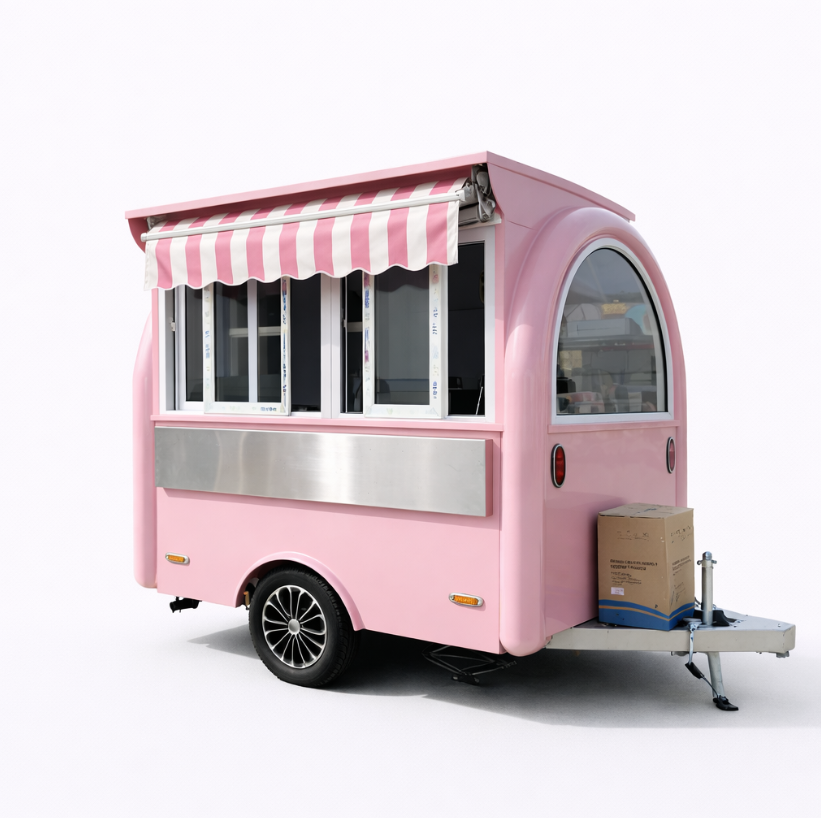
Start With a Real Load Schedule
A commercial food trailer lives or dies by its electrical load schedule. Before choosing a generator or shore cord, list every load by circuit: fridge, freezer, exhaust fan, hood lights, fryer, griddle, coffee brewer, POS, signage, water pump, A/C, and small appliances. Mark each as continuous or intermittent, then record nameplate amps and volts. Nameplate numbers are not reality. A 1,500 W fryer cycles, while a 1/2 hp condenser motor can spike to three or four times running amps on start.
Build the schedule with running watts, surge watts, hours per service day, and duty cycle. Add 25 percent headroom for continuous loads. A trailer with a two-door fridge, chest freezer, exhaust hood, lights, POS, and 12,000 BTU A/C often lands between 3.5 kW and 5 kW running. Add a griddle or fryer and the number can pass 8 kW. That gap decides whether a 30 A cord, 50 A cord, or generator is needed.
During a Mobile, Alabama, retrofit for a coastal BBQ operator, the first load study showed 6 kW running. Lunch-rush clamp data showed 9.8 kW peaks when freezer, A/C, and fryer cycled together. A bigger generator alone did not fix it. Staggering the fryer and adding an A/C soft starter solved the nuisance trips.
Match Supply Type to the Site
Power supply is a site problem as much as an equipment problem. A brewery pedestal differs from a construction lot with no grid access. Shore power, generator, battery/inverter, and hybrid are the main paths.
Shore power is quiet and cheap per kWh, but the cord, inlet, and panel must match the pedestal. In North America, 120/240 V split-phase 50 A is common for larger units. Smaller units may use 120 V 30 A. Europe often uses 230 V 50 Hz single-phase or 400 V three-phase. A 50 A 240 V shore connection gives about 12 kW theoretical, but voltage drop reduces usable capacity. Long cords create voltage drop that can overheat compressors.
Generators bring independence, with noise, exhaust, fuel storage, and maintenance. Diesel tolerates long runs and heavy loads. Gasoline and propane units are lighter and quieter but need fuel management. Inverter generators clean up power, but motor starting still demands surge capacity.
Battery/inverter systems run silent and produce no local emissions. They suit low-to-moderate loads, short service windows, and locations with charging access. Lithium iron phosphate banks discharge deeply, but the inverter must handle surge and the charger must refill the bank between events. Without a realistic charge plan, a battery system becomes a heavy paperweight.
| Supply option | Typical usable capacity | Strength | Main limit | Best fit |
|---|---|---|---|---|
| Shore power | 3.6 kW at 30 A/120 V; 12 kW at 50 A/240 V | Quiet, low operating cost | Site dependent, voltage drop | Fixed pitches, commissaries, powered events |
| Diesel generator | 6 kW to 20 kW | High surge, long runtime | Noise, exhaust, fuel | Remote sites, heavy cooking |
| Battery/inverter | 3 kW to 10 kW | Silent, no emissions | Recharge time, weight | Low loads, short shifts, noise-sensitive areas |
| Hybrid | 6 kW to 15 kW | Smaller generator, quiet hours | Controls complexity | Mixed loads, overnight events |
Size the Generator Around Motor Starts
Generator sizing is not a wattage match. Start with running kW, then add the largest motor surge. A typical commercial food trailer with 12,000 BTU A/C, two fridges, lights, and a small fryer might run at 4.5 kW. If the A/C compressor starts while the fryer is on, surge can hit 9 kW to 12 kW for a few seconds. An 8 kW continuous generator may or may not handle that, depending on motor-start rating and alternator design.
Duty cycle matters. A diesel generator running at 25 percent load for hours can wet-stack. One running at 90 percent wears faster and burns more fuel. Aim for 50 to 75 percent of continuous rating on heavy cooking days. For propane or gasoline, check fuel consumption at half load and full load. A 7 kW gasoline generator may burn roughly 0.7 to 1.0 gallons per hour under load. That number decides refuel intervals.
NFPA 1192 and NEC Article 551 provide useful framework for wiring and grounding in mobile units, though local health and electrical authorities have final say. Transfer switches must prevent shore and generator power from meeting. Inlet ratings, breaker sizing, and conductor ampacity need coordination.
Build the Distribution Panel for Kitchen Reality
The panel is where a food trailer becomes reliable or becomes a nuisance. Split loads into separate breakers: refrigeration, cooking, HVAC, lights, pumps, and general receptacles. A tripped fryer circuit should not kill the fridge. Use GFCI protection for receptacles near water, including sinks, handwash stations, and exterior outlets. AFCI may be required in some jurisdictions for certain circuits, so check local code.
Route wiring away from heat, sharp edges, and grease. Use stranded copper for vibration resistance. Terminals need proper ferrules or approved connectors. A common failure in mobile kitchens is a loose neutral on a multiwire branch circuit, which can send 240 V through 120 V loads and destroy electronics.
Label every breaker and receptacle. During a dinner rush, tracing a dead circuit through a dark trailer wastes time. Leave spare breaker spaces for future loads. Spare capacity costs little during build and saves a lot later.
Commissioning Checks That Prevent Mid-Service Shutdowns
Before first service, run a full load bank or simulated load test. Check voltage at the panel, at the farthest receptacle, and at compressor terminals. Measure voltage drop under load. Verify polarity, ground bond, and GFCI trip times. Confirm generator frequency stays near 60 Hz or 50 Hz depending on region. Low frequency can damage motors and electronics.
Document the load schedule, breaker map, and fuel or charge plan. Train staff on what to do if a breaker trips or a generator faults. Keep spare fuses, a clamp meter, and a basic outlet tester onboard. A power system that is understood is far less likely to fail during the rush.
For operators scaling from one unit to a fleet, Mingtai offers mobile commercial manufacturing capacity, model variety, and supply chain support that can help align power specs with real kitchen loads.